

Christian Transhumanism thinks deeply about epistemology. Engaging with secular minds, we focus on critical rationalism. Engaging with Christians, we sometimes get accused of being insufficiently ‘biblical’. This blog is a response to those criticisms.
There’s a common but mistaken assumption that a “high view” of Scripture requires treating it as the only legitimate source of theological knowledge; that reason, tradition, and experience are, at best, tolerated intruders. This is particularly a trap some Calvinists fall into, with Calvin’s doctrine of total depravity obscuring the Imago Dei.
Some Christians echo Luther’s “Sola Scriptura”. But it is important to distinguish Luther’s use of that phrase against corruption in the church from a normative use of a sole authority. After all, simple observation tells us those who proclaim “Sola Scriptura” commonly mean “Sola My Interpretation…”
In reality, all Christians use something like the Wesleyan Quadrilateral: Scripture, Tradition, Reason and Experience. Some fundamentalist Christians decry this. Leaders of the failed new atheist movement of 20 years ago slandered Christians for believing in “sola scriptura”. They alleged the Bible was dismissive of human critical thinking, when Christians believe it to be an important feature of the Imago Dei.
What’s often missed is that Scripture itself repeatedly points beyond its own pages to creation, to conscience, to reasoned argument, to lived experience, to the accumulated wisdom of other cultures. The Bible legitimizes these as sources by which truth about God and the world can be found. If that’s right, then honoring Scripture’s own testimony about knowledge actually requires something like the Quadrilateral.
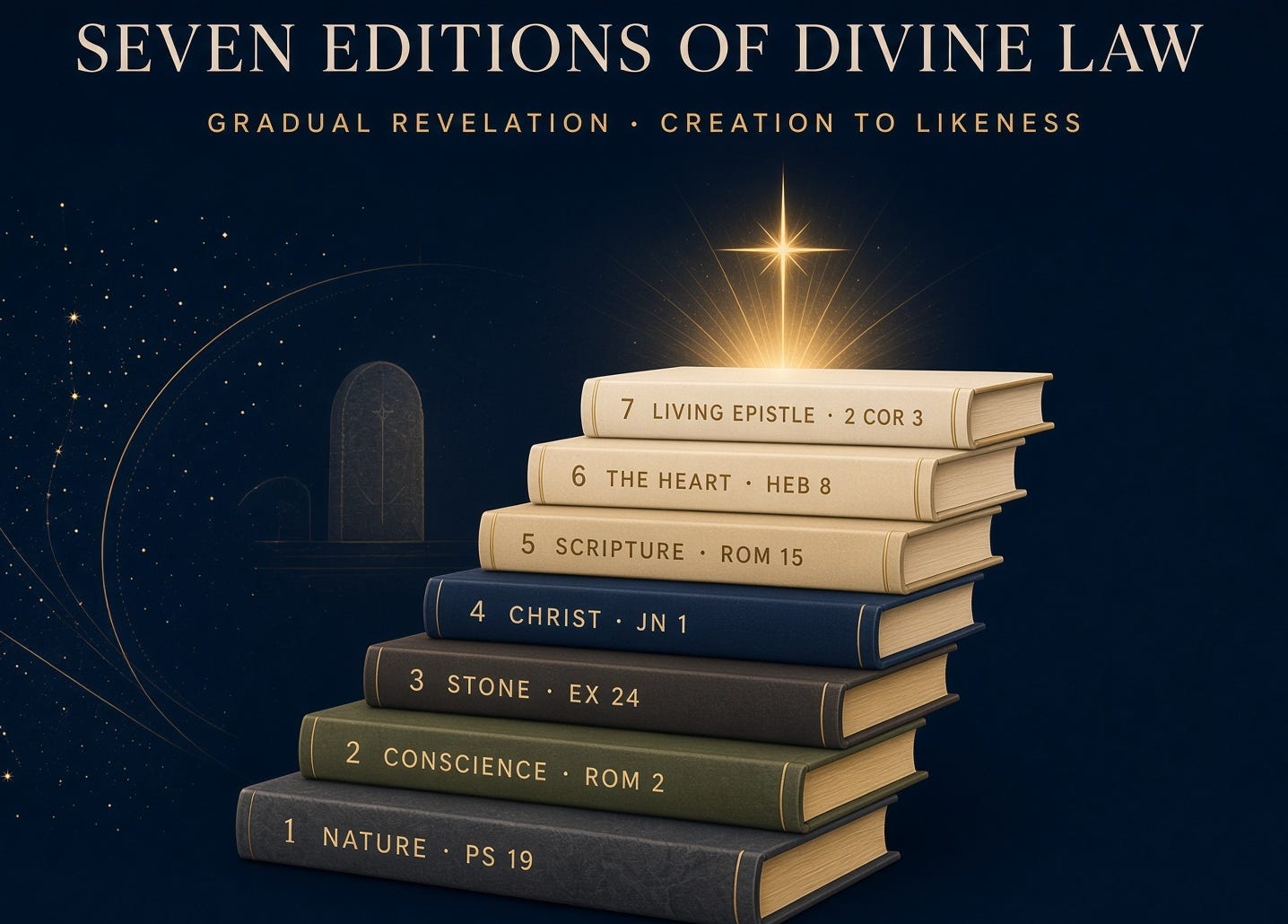
The image above reflects FC Thompson’s “Seven Editions of the Divine Law” from the Thompson Chain Reference Bible, a similar theme.
Below is a working catalogue of the biblical case, organized by theme, with the theological anthropology underlying it made explicit. In the Genesis allegory, humankind was not created as an empty vessel waiting for God to send a book. It was made in the Image of God, with the ability to grow in intelligence, compassion, wisdom and knowledge.
General Revelation: Creation Itself Testifies
The most direct biblical claim that truth is available outside the text of Scripture is the doctrine of general revelation. That is, that the created order itself communicates real knowledge of God.
Psalm 19:1–4 — The heavens declare the glory of God; day to day pours out speech; their voice goes out through all the earth. There is no speech, yet the speech is universal.
Romans 1:19–20 — God’s eternal power and divine nature are “clearly perceived” in what has been made, leaving humanity without excuse.
Job 12:7–10 — “Ask the animals, and they will teach you, or the birds in the sky, and they will tell you; or speak to the earth, and it will teach you.” Creation is a classroom..
Job 38–41 — God’s entire speech from the whirlwind is an extended appeal to the created order (wild goats, ostriches, Leviathan, the storehouses of snow) as a source of humbling knowledge.
Isaiah 1:3 — even the ox knows its owner; nature’s basic recognitions shame Israel’s ignorance.
Isaiah 40:26 — “Lift up your eyes and look to the heavens: Who created these?” Observation is commanded.
Acts 14:17 — Paul tells the crowd at Lystra that God “did not leave himself without witness,” pointing to rain and fruitful seasons as evidence available to pagans who had no access to Torah.
Acts 17:24–28 — The God who made the world determined times and boundaries so that people would seek him and perhaps find him; “in him we live and move and have our being.”
Conscience and Moral Law Written on the Heart
Paul makes an explicit case that moral knowledge exists independent of the written law, planted in human nature itself.
Romans 2:14–15 — Gentiles who never received the law nonetheless “by nature” do what the law requires, showing the law’s work “written on their hearts,” with conscience bearing witness.
Romans 9:1 and 2 Corinthians 1:12 — Paul appeals to his own conscience, “confirmed by the Holy Spirit,” as a source of testimony about his integrity.
1 Timothy 1:5 — love is said to flow “from a pure heart, a good conscience, and a sincere faith,” treating conscience as a real moral faculty alongside faith.
1 Peter 3:16, 21 — a “good conscience” functions as something Christians must keep and can appeal to before others.
Genesis 20:3–9 — Abimelech, a pagan king, is horrified at the thought of taking another man’s wife: “Will you slay a righteous nation?” Moral knowledge outside Israel.
Acts 10:1–2, 34–35 — Cornelius fears God and practices righteousness before he hears the gospel. Peter: in every nation the one who fears God and does what is right is acceptable to him.
Reason and the Rational Testing of Truth
Scripture doesn’t just permit reasoning — it commands it, and models it, including reasoning that weighs claims made within the community of faith.
Isaiah 1:18 — “Come now, let us reason together,” God’s own invitation to rational engagement rather than blind assertion.
Proverbs 2:2–6 — Incline your ear to wisdom, apply your heart to understanding; the Lord gives wisdom; from his mouth come knowledge and understanding.
James 1:5 — If anyone lacks wisdom, let him ask God, who gives generously to all without reproach.
2 Timothy 2:7 — “Think over what I say, for the Lord will give you understanding in everything.”
Luke 12:56 — Jesus rebukes the crowd for being skilled at reading the weather but failing to “interpret the present time,” treating the failure to reason well as culpable.
Acts 17:11 — the Bereans are commended as “more noble” precisely because they didn’t take even the apostle Paul’s word uncritically, but “examined the Scriptures daily to see if these things were so.”
1 Thessalonians 5:21 — “test everything; hold fast what is good,” a general epistemic principle, not limited to prophetic utterances.
1 Corinthians 14:29 — even prophetic speech in the gathered church is to be weighed by others, building communal, reasoned discernment into worship itself.
2 Corinthians 2:6–7 — Paul treats the judgment reached “by the majority” of the congregation as a sufficient and binding form of communal discernment, not something that needed a fresh direct revelation to validate it.
Philippians 4:8 — Whatever is true, honourable, just, pure, lovely, commendable—if there is any excellence, any praise—think about these things. This reads like a Hellenistic virtue catalogue. Paul does not invent a separate Christian list; he commands attention to excellence wherever it appears.
Wisdom as a Universal, Cross-Cultural Category
The wisdom literature is the clearest biblical evidence that Israel understood wisdom as something pursued and partially attained by people outside the covenant community, not a possession unique to revealed law.
Proverbs 1:5, 1:20–21 — wisdom “cries aloud in the street,” addressing the public square rather than a privileged religious enclave.
Proverbs 2:2–6 — wisdom is something to be searched for “like hidden treasures,” implying an active human quest rather than passive reception of dictated content.
Proverbs 25:2 — “it is the glory of kings to search things out,” dignifying investigation itself as a royal, God-honoring vocation.
Jeremiah 8:7 — The stork, dove, swift, and thrush know their seasons; Israel does not know the requirements of the Lord. Nature keeps time better than the covenant people sometimes do.
Isaiah 28:23–29 — The farmer’s knowledge of ploughing, sowing, and threshing is itself instruction from the Lord of hosts, “who is wonderful in counsel and excellent in wisdom.” Agricultural skill is not secular leftover. It is divine pedagogy through ordinary work.
Ecclesiastes 1:13 — the Preacher applies his heart “to seek and search out by wisdom” everything done under heaven, a program of open empirical and philosophical inquiry.
1 Kings 4:29–34 — Solomon’s wisdom is explicitly compared to, and said to exceed, “all the people of the east” and “all the wisdom of Egypt,” acknowledging real wisdom traditions existing outside Israel that Solomon’s is measured against.
Proverbs 22:17–24:22 — scholars have long noted this section’s close structural parallels to the Egyptian “Instruction of Amenemope,” suggesting Israel’s wisdom writers directly incorporated and adapted wisdom from a foreign, non-Israelite source.
Proverbs 30:1–33 and 31:1–9 — attributed respectively to Agur and King Lemuel, both apparently non-Israelite (Massaite) figures, folded directly into the canon as bearers of true wisdom.
Gentile Poets, Playwrights, and Prophets Cited as True
Perhaps the most striking category: New Testament authors directly quote pagan literary sources as authoritative statements of truth.
Acts 17:28 — Paul, preaching at the Areopagus, quotes the Cretan philosopher-poet Epimenides (”in him we live and move and have our being”) and the Stoic poet Aratus (”we are indeed his offspring”), building his argument on non-biblical sources.
Titus 1:12 — Paul quotes “one of their own prophets,” the Cretan poet Epimenides again, this time approvingly citing a piece of pagan cultural self-criticism as accurate.
1 Corinthians 15:33 — Paul quotes a line from the Greek comic playwright Menander (”bad company ruins good morals”) as a true moral maxim, embedding secular literature into apostolic instruction.
Jude 1:14–15 — Jude cites material from the non-canonical Book of Enoch as a genuine prophetic statement about judgment, showing that truthful content wasn’t confined to what later became the closed canon.
John 1:1 — Logos is not a Hebrew word. Heraclitus used it for the rational order of the cosmos, and Stoics for the divine reason pervading all things. John kept the public philosophical term and advanced it.
Discernment by Fruit and Experience
Scripture repeatedly directs believers to test claims not by abstract argument alone, but by observed outcomes and lived experience. That is, an empirical, experiential mode of knowing.
Matthew 7:16–20 — “you will recognize them by their fruits,” making observable results a legitimate test of a claim’s truth.
Galatians 5:22–23 — the “fruit of the Spirit” is presented as a recognizable, experientially verifiable pattern distinguishing genuine spiritual life from its counterfeits.
Philippians 4:8–9 — believers are told to dwell on “whatever is true, honorable, just, pure, lovely, commendable,” language drawn from the wider vocabulary of Greco-Roman virtue ethics, and then to practice what they have both “learned and received and heard and seen” — explicitly naming observed example as a channel of formation.
1 John 4:20–21 and James 2:14–18 — both test the truth of professed love or faith by whether it shows up in lived, observable action.
Hebrews 5:14 — spiritual maturity is defined as having, “through practice,” senses “trained to distinguish good from evil” — knowledge built through experience and repetition, not just propositional instruction.
Tradition and Communal Discernment
Scripture also depicts truth being clarified through structured communal deliberation, not solely through individual reception of a text.
Acts 15:1–29 — the Jerusalem Council resolves a major doctrinal dispute through apostolic deliberation, testimony, appeal to experience (what God had done among the Gentiles), and communal decision — a strikingly Quadrilateral-shaped process in miniature.
2 Thessalonians 2:15 — believers are told to “stand firm and hold to the traditions” taught, whether by letter or by spoken word, treating oral tradition as authoritative alongside written instruction.
2 Timothy 2:2 — Paul instructs Timothy to entrust what he has heard to “faithful men” who will teach others also, establishing a chain of transmitted, tradition-carried truth.
Jude 1:3 — appeals to “the faith that was once for all delivered to the saints,” a received deposit rather than a private discovery.
Theological Anthropology: Why Any of This Is Possible at All
The above texts reflect the theological reason humans are capable of perceiving truth through reason, conscience, wisdom, and experience in the first place. That reason is the imago Dei.
Genesis 1:26–28 — humanity is made “in the image and likeness of God,” the foundational claim that human faculties of mind and will bear a real, if creaturely, reflection of God’s own rational and creative nature.
Genesis 2:19–20 — Adam’s naming of the animals is an act of intellectual discernment and creative categorization, an early picture of the image-bearer exercising reasoned understanding of the created world.
Job 32:8 — Elihu’s claim that “it is the spirit in man, the breath of the Almighty, that makes him understand,” grounding human understanding directly in God’s own life-giving breath.
Psalm 8:3–6 — humanity is described as crowned “with glory and honor” and given dominion, a status that implies real competence, not mere passivity, in relating to and understanding the world.
Colossians 2:2–3 — “all the treasures of wisdom and knowledge” are hidden in Christ, meaning the wisdom found scattered elsewhere is not a rival to Christ but is ultimately gathered up and fulfilled in him.
Colossians 3:9–10 — believers “put on the new self, which is being renewed in knowledge after the image of its creator,” directly tying the ongoing renewal of the mind to the imago Dei.
James 1:5, 1:17 — wisdom is something God gives generously to anyone who asks, and every good gift, explicitly including intellectual gifts, comes “from the Father of lights.”
2 Peter 1:3–4 and 3:18 — believers are called to “grow in the grace and knowledge of our Lord,” language of ongoing intellectual and spiritual maturation rather than a closed, static deposit of facts.
Ephesians 4:13–14 — the goal of the church’s teaching ministry is a maturity that is no longer “tossed to and fro” by every wind of doctrine, which itself presumes growing discernment as a skill to be developed, not simply information to be received once.
Putting It Together
Read this way, the case for the Wesleyan Quadrilateral isn’t an accommodation to modern pluralism. Rather, it’s an argument from Scripture’s own self-understanding. The Bible depicts creation as speaking eloquently, conscience as instructive, reason as commanded, cross-cultural wisdom as real, communal deliberation as authoritative, and lived experience as diagnostic. It even directly incorporates non-Israelite wisdom (Amenemope), a non-Israelite sage’s oracle (Agur), a foreign queen mother’s counsel (Lemuel), and pagan Greek poets and playwrights (Epimenides, Aratus, Menander) into its own authoritative text. John’s gospel opens with the concept of the “Logos” a concept with 500 years history of Greek thought.
Thus, to gain true knowledge and wisdom, we must Scripture, Tradition, Reason and Experience, without interpreting one of these sources in a manner antithetical to the others, considering all wisdom. We must use all four sources of Spirit-breathed testimony to the God whose fingerprints are, on the Bible’s own account, legible everywhere else too.