
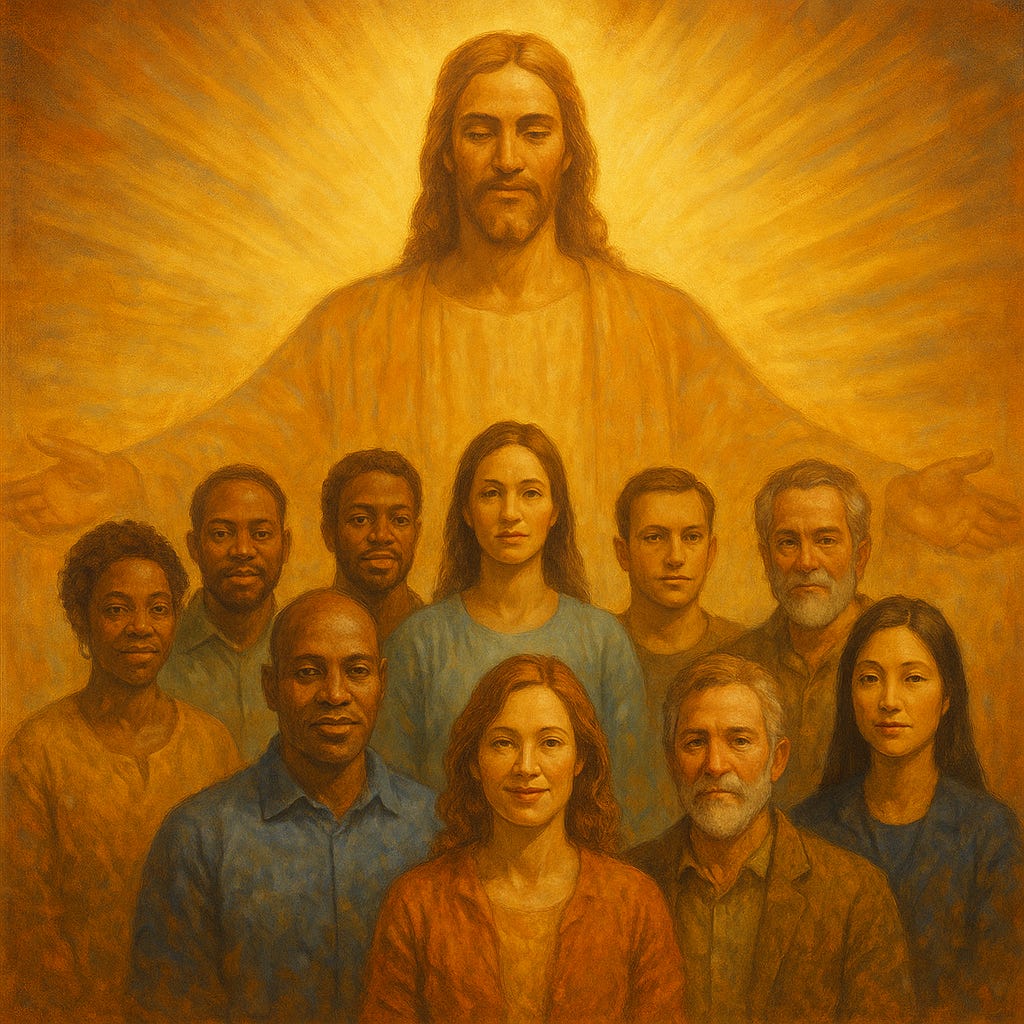
The Body of Christ: A Divine Blueprint for Individual Potential and Collective Harmony
In our previous exploration, we traced the biblical journey from the meritocratic judges to the servant leadership of Jesus’ Kingdom of God, envisioning a divine meritocracy where technology and faith empower a just society. Central to this vision is the New Testament’s metaphor of the “body of Christ” (1 Corinthians 12:12-27), where each believer contributes unique gifts to a unified whole. This framework not only resonates with insights from evolutionary biology and Jungian psychology but also challenges the limitations of capitalist and Marxist systems. By integrating Artificial Superintelligence (ASI), we can imagine a governance model that amplifies individual potential while fostering collective harmony, offering a superior alternative to secular ideologies.
The Body of Christ: Unity in Diversity: One Body, Many Callings
The Apostle Paul describes the church as the “body of Christ,” where each member—likened to hands, feet, or eyes—has distinct roles yet contributes to a single purpose. This metaphor celebrates individual talents while emphasizing interdependence, rejecting uniformity in favor of a dynamic unity where “if one part suffers, every part suffers with it” (1 Corinthians 12:26). For Christian transhumanists, this vision aligns with the pursuit of a society where every person’s unique calling is nurtured, empowered by faith and technology to serve the greater good.
Evolutionary Biology and Jungian Archetypes: The Roots of Individuality
Evolutionary biology reveals that diversity is a cornerstone of life. Natural selection favors variation, enabling species to adapt through specialized traits—much like the diverse roles in the body of Christ. This biological diversity parallels the psychological insights of Carl Jung, who proposed archetypes as universal patterns in the human psyche. Archetypes like the Hero, Sage, or Caregiver emerge from our evolutionary heritage, shaping individual personalities and talents. For example, some are drawn to leadership (the Hero), others to wisdom (the Sage), reflecting innate predispositions that align with Paul’s vision of diverse yet complementary gifts.
In the body of Christ, these archetypal roles are sanctified, guided by divine purpose. Unlike evolutionary processes, which are undirected, the Christian framework sees individuality as a God-given design, where each person’s unique skills contribute to a redemptive mission. This perspective celebrates the biological and psychological roots of diversity while elevating them through spiritual purpose.
Capitalist Systems: Forcing Square Pegs into Round Holes
Capitalism, as articulated by Adam Smith, emphasizes individual initiative and market-driven specialization. While this can foster innovation, it often reduces people to cogs in an economic machine, prioritizing profit over personal calling. Workers are frequently forced into roles that align with market demands rather than their innate talents or archetypes. A caregiver archetype, for instance, might be funneled into a high-paying but unfulfilling corporate role, stifling their potential and leading to alienation.
Marxist Systems: The Myth of the Blank Slate
Marxism, in contrast, views humans as blank slates shaped by class structures, with economic conditions dictating roles and potential. Karl Marx argued that class struggle defines society, advocating for a system where collective equality overrides individual differences. This approach, however, dismisses the biological and psychological diversity emphasized by evolutionary biology and Jungian archetypes. By assuming the blank-slate view of human nature, that all life outcomes derive from nurture based on class, Marxism risks suppressing the unique gifts Paul celebrates, forcing individuals into a one-size-fits-all framework that ignores their God-given callings. The body of Christ, by contrast, values both individual uniqueness and collective harmony, avoiding the reductionism of class-based ideologies.
A Superior Metaphor: Beyond isms: A blueprint for flourishing
The body of Christ transcends the limitations of both capitalism and Marxism. Unlike capitalism’s market-driven roles, it honors each person’s unique gifts, ensuring that no one is reduced to a mere economic function. Unlike Marxism’s blank-slate uniformity, it celebrates diversity as a divine design, rooted in the biological and psychological realities of human individuality. This metaphor aligns with Christian Transhumanist ideals, envisioning a society where technology amplifies personal potential within a community united by love and service. It embodies a divine meritocracy where leadership is about serving others, not accumulating wealth or power.
Support from Church Fathers
Augustine’s City of God offers a foundational theological vision of society, contrasting the earthly city—driven by self-interest and domination—with the heavenly city, oriented toward love of God and mutual service. This dualism underscores the moral dimension of all governance structures: they either reflect divine order or distort it. In this light, the body of Christ becomes more than a metaphor—it becomes a template for a redeemed polis, where each part serves the whole in love. An ASI-aligned governance system must therefore be more than efficient; it must be oriented toward the values of the heavenly city.
Thomas Aquinas deepens this vision through his teleological ethics, affirming that every person is ordered toward a divinely intended end. Society, in Aquinas’s view, should enable individuals to realize their full potential in community, reflecting Paul’s vision of the church.
Envisioning Governance with ASI: Amplifying the Body of Christ
Imagine a governance model where Artificial Super Intelligence, or ASI—a highly advanced form of artificial intelligence—supports the body of Christ’s vision. Unlike centralized systems that impose roles, ASI could analyse individuals’ talents, archetypal predispositions, and spiritual callings, guiding them toward roles that maximize their potential. For example, ASI could identify a person’s aptitude for teaching (a Sage archetype) and connect them with opportunities to educate, whether through traditional schools or innovative platforms. By leveraging data on biological, psychological, and spiritual dimensions, ASI could foster individuation—the Jungian process of becoming one’s true self—while ensuring societal needs are met.
Such a system would prioritize transparency and accountability, avoiding the pitfalls of capitalist greed or Marxist rigidity. ASI could optimize resource allocation, ensuring that no one is left behind, mirroring the body of Christ’s care for every member. For Christian transhumanists, this aligns technology with faith, creating a society where individuals flourish as part of a redemptive whole.
The Call to Action
The body of Christ offers a timeless blueprint for a society that honors individuality and unity. By drawing on evolutionary biology’s insights into diversity and Jungian archetypes’ celebration of psychological uniqueness, we see that humans are neither blank slates nor economic units but divinely crafted contributors to a greater purpose. As Christian Transhumanists, we can champion governance systems that use ASI to empower each person’s calling, creating a divine meritocracy that reflects God’s kingdom.
Part of the CTA’s calling is to articulate the future of humanity as we transcend current biological limitations. Therefore, we need to understand both the nature of individuality in our species (balance of nature and nurture which the fundamentalist views of both left and right get wrong) and the way our societies can function for maximum human excellence. This approach stands firmly in the tradition of Christian political theology: seeking justice not through control, but through calling.
Let us reject the limitations of capitalism and Marxism, embracing instead a vision where technology and faith unite to build a world of justice, flourishing, and love—a true embodiment of the body of Christ.