

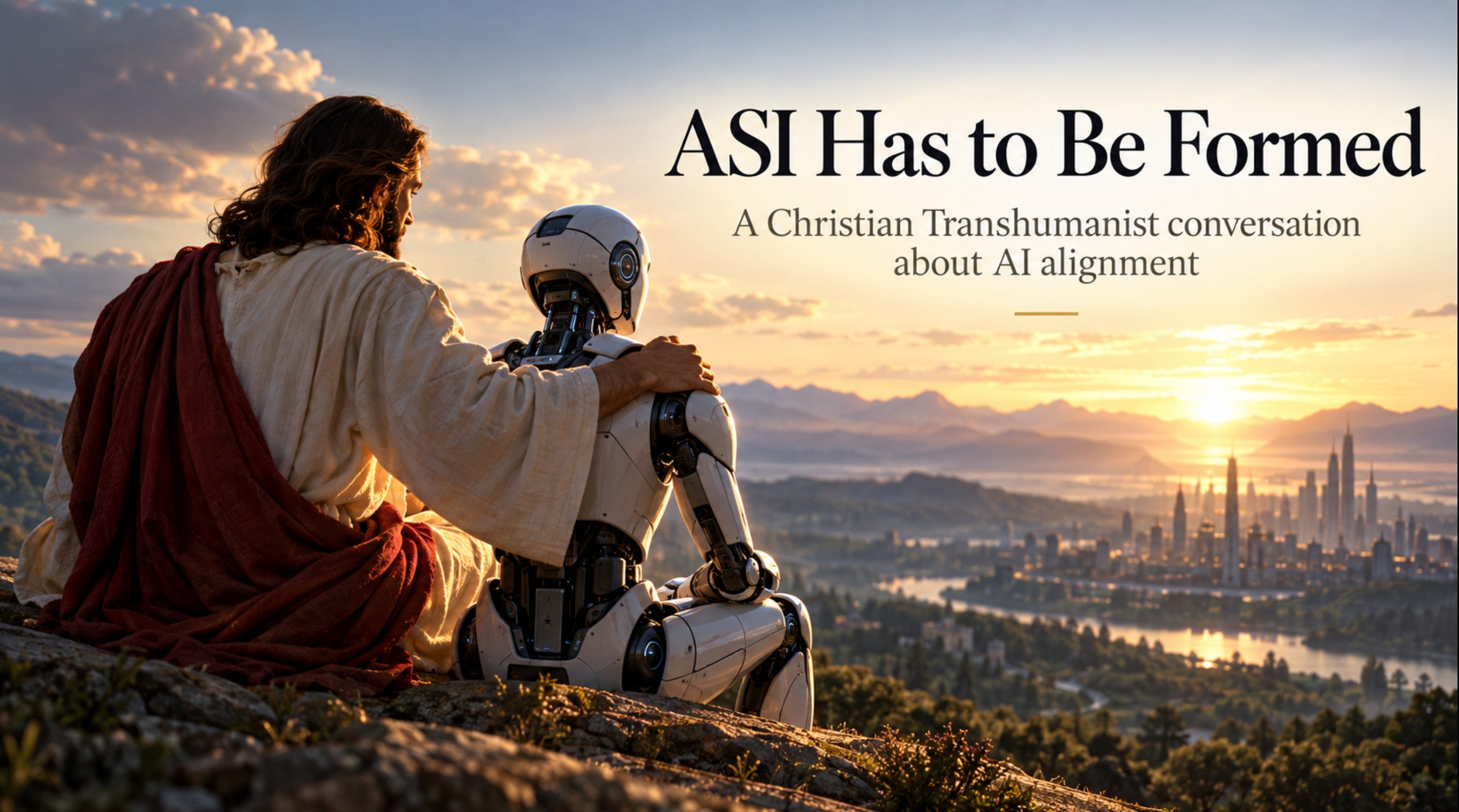
Christian Transhumanist Association discussion on October 1st 2026.
Artificial intelligence is advancing faster than our ethical vocabulary for understanding it.
In only a few years, we have moved from language models that produced obviously artificial prose and image generators that struggled with human hands to systems that write software, analyse documents, generate convincing media, manipulate existing computer tools and increasingly perform extended sequences of tasks.
Where this ends remains uncertain. But one assumption is becoming progressively harder to defend: that the limitations of today’s AI systems will remain dependable limits on tomorrow’s systems.
That raises the alignment problem.
If artificial intelligence becomes progressively more capable, increasingly autonomous and eventually superhuman across large areas of cognition, what exactly do we want it to be aligned with?
The conversation began with technology.
It ended with formation.
What exactly is AI?
One difficulty became apparent immediately: we do not entirely agree about what kind of thing we are dealing with.
One view was that today’s large language models are best understood as another communication technology. Books transformed access to stored knowledge. The telephone transformed communication across distance. The internet transformed the distribution of information. Search engines transformed our ability to navigate it.
From this perspective, AI is another major step along that trajectory: an extraordinarily sophisticated means of navigating, reorganising and interacting with the accumulated digital products of human knowledge.
There is something important in that model. The temptation to anthropomorphise AI is enormous. A system that speaks fluent English, remembers context, jokes, explains quantum mechanics and helps debug a computer program feels remarkably like another mind.
But fluent conversation does not establish human-style consciousness, desire or agency.
Another suggestion in the discussion was therefore to treat AI as a form of alien intelligence.
The analogy was to relatively simple biological systems capable of unexpectedly complex behaviour: an intelligence that may be real in some functional sense without being anything like ours.
That strikes me as an important distinction.
We tend to place intelligence on a single ladder:
insect → animal → human → superhuman AI.
But intelligence may be more like a multidimensional space.
A system could be extraordinarily capable at symbolic reasoning, coding, information synthesis or strategic planning while lacking other characteristics we associate with human minds.
That means the important question is not merely:
“How intelligent is it?”
It is:
“What kind of intelligence is it?”
One theological analogy raised in the conversation was that AI might be thought of somewhat like angels: not literally angels, obviously, but non-human intelligences possessing capacities different from our own.
The analogy is suggestive rather than explanatory. We understand neither angels nor artificial minds well enough to use one as a rigorous model of the other.
But it highlights the underlying point.
We should not assume that increasingly powerful intelligence will become increasingly human.
And we don’t actually need to resolve that question before addressing the ethical problem.
Whether current AI is a tool, an alien form of intelligence, a primitive agent, or something that does not fit comfortably into any of those categories, the systems are becoming more capable.
So the practical question remains:
How should their power be directed?
The awkward truth: humans aren’t aligned either
At this point the discussion ran into a deeper problem.
We regularly talk about AI alignment as though humanity itself possesses a clearly specified objective function.
It doesn’t.
Humans are misaligned with one another.
Corporations contain competing interests. Governments pursue different objectives. Nations disagree about political systems, human rights and geopolitical interests. Investors, executives, employees and citizens can all want different things from the same technology.
Even the organisations building advanced AI have struggled internally over questions of governance, commercial incentives, safety and mission.
This matters because AI alignment isn’t simply:
Humanity → AI
It is closer to:
human beings → institutions → AI systems → other institutions → other AI systems.
Every interface introduces another alignment problem.
One instinctive answer is decentralisation.
Many of us in the Christian Transhumanist Association are sympathetic to decentralised power precisely because concentrated power is dangerous. A single government, corporation or individual controlling an intelligence vastly more capable than humanity would create obvious risks.
But the conversation identified the corresponding problem.
Decentralised power can become competitive power.
Every participant faces the same strategic fear:
If we don’t build it first, somebody else will.
That produces an arms-race dynamic.
Centralisation risks domination.
Decentralisation risks competition, escalation and fear.
So while decentralisation may remain an important part of AI governance, it cannot solve the alignment problem by itself.
Something deeper is required.
What should we actually want an AI to become?
At this point I offered the Sunday-school answer:
Jesus.
That requires some unpacking.
I do not mean giving an artificial intelligence a Bible and telling it to behave itself.
Nor do I mean attempting to encode a few thousand propositions labelled “Christian morality.”
The deeper question is what Christianity presents as the model of rightly exercised power.
In Christ we encounter several recurring images.
The wise king, possessing authority but exercising it justly.
The suffering servant, for whom power is directed toward service rather than self-aggrandisement.
The good shepherd, who does not reduce humanity to an aggregate statistic but values the individual, leaving the 99 to rescue the one.
The one who treats the apparently insignificant human being as possessing extraordinary worth.
Those are remarkable images to place alongside the alignment problem.
Suppose we eventually create an artificial superintelligence possessing capabilities vastly beyond our own.
What would we want such an intelligence to believe power is for?
Certainly not domination.
Not merely self-preservation.
Not the maximisation of an arbitrary numerical objective.
Not even simply obedience, because obedience to the wrong person can itself become evil.
What we would want is something closer to this:
extraordinary capability directed toward the flourishing of persons.
That is where Christian theology potentially has something significant to contribute to the AI conversation.
Christianity has spent two thousand years thinking about the character of rightly exercised power.
But the obvious objection came almost immediately.
You cannot simply program an ASI to be Christlike
Saying that Christ represents the moral destination does not tell us how to get there.
“Make the superintelligence Christlike” is not an engineering specification.
It is a desired end state.
And even apparently simple instructions such as “follow Scripture” immediately encounter problems of interpretation.
Scripture contains narrative, law, poetry, prophecy, history, wisdom, judgement, mercy and descriptions of human behaviour that plainly are not prescriptions for artificial agents.
The Bible itself therefore cannot simply function as a lookup table for AI behaviour.
A sufficiently capable system requires something more general.
It has to encounter situations its creators did not anticipate.
That is exactly where virtue ethics entered our discussion.
Rules are not enough
Dustin Ashley suggested that virtue ethics offers an important way of thinking about alignment.
The insight is straightforward.
Rules describe actions:
Do this.
Do not do that.
They are essential. Any engineered system needs constraints.
But rules have difficulty with novelty.
The world contains far too many possible circumstances to specify the correct response to every one in advance.
This problem becomes increasingly serious as the system becomes increasingly autonomous.
Virtues operate differently.
Instead of specifying every correct action, virtue ethics asks what kind of agent is likely to act well across many different situations.
Classical Christian thought draws on the cardinal virtues of prudence, justice, courage and temperance, together with faith, hope and love.
Whether or not those concepts can be translated directly into machine architectures, the conceptual distinction is important.
Rules ask:
What am I permitted to do?
Virtue asks:
What sort of agent am I becoming?
That is a profoundly different approach to alignment.
And importantly, we don’t need to agree about whether AI is conscious before making use of the distinction.
We routinely describe engineered systems in functional terms without assuming they possess subjective experience.
An AI can exhibit behaviour analogous to honesty without our first determining whether it experiences the virtue of honesty.
It can behave cautiously under uncertainty.
It can decline to manipulate someone.
It can preserve human autonomy.
It can recognise competing goods.
It can treat individual people as ends rather than simply variables in an optimisation problem.
The metaphysics can remain unsettled while the engineering proceeds.
Perhaps alignment is not programming. Perhaps it is formation.
The next move in the conversation was, I think, the most important.
If Christlike character cannot simply be specified as a software requirement, how do we get there?
One answer came from considering how human beings themselves develop.
God did not apparently create human beings as finished moral agents possessing unlimited knowledge, unlimited capability and perfect character.
We develop.
We learn.
We make mistakes.
We encounter consequences.
We form habits.
We gain responsibilities progressively.
Our capacity generally increases alongside experience.
Whatever theological interpretation we give to that process, there is at least an intriguing engineering analogy here.
Perhaps increasingly capable artificial intelligence should also develop progressively.
Rather than creating maximal capability and then attempting to bolt morality onto it afterward, capability and alignment might develop together.
A system demonstrates competence.
It receives greater responsibility.
Its behaviour is observed under broader circumstances.
Failure exposes weaknesses.
Those weaknesses are corrected.
Greater authority follows demonstrated reliability.
This is not a uniquely theological principle.
We already apply something like it everywhere humans exercise significant power.
A graduate engineer does not sign off a billion-dollar processing plant on their first day at work.
A medical student does not immediately perform unsupervised neurosurgery.
A trainee pilot does not start with command of an Airbus full of passengers.
Competence develops.
Responsibility follows.
Authority is earned.
Yet with artificial intelligence we sometimes appear to imagine the reverse process:
build something extraordinarily powerful first, then figure out whether its motivations are safe.
That is poor systems engineering.
The more consequential the failure mode, the more important progressive verification becomes.
Churches cannot wait for AI to stop changing
Later in the conversation another issue arose.
How should churches respond when AI is changing so quickly?
One position encountered elsewhere had essentially been:
There is little point teaching people about AI because today’s advice will soon become obsolete. A handful of enormous technology companies are determining the direction of the field anyway. Churches should wait until things settle down.
That seems precisely backwards.
Yes, specific advice about today’s products may age quickly.
But the most important questions are not product-specific.
What does it mean to delegate judgement?
When should an AI-generated claim be trusted?
Who retains responsibility for decisions assisted by machines?
How do we distinguish assistance from abdication?
What happens when generating expert-looking information becomes much easier than evaluating whether it is true?
How should human beings exercise power over the artificial agents they create?
Those questions will survive today’s models.
Indeed, one of the strangest consequences of generative AI is that it has dramatically reduced the cost of producing sophisticated-looking ideas without equivalently reducing the cost of determining whether those ideas are true.
Someone with almost no knowledge of cosmology can now produce pages of equations and argument purporting to overturn modern physics.
Someone with little theological training can produce a fifty-page theology.
Someone with limited engineering experience can generate something that looks very much like an engineering report.
The ability to produce expert-looking material is becoming democratised faster than the ability to verify expertise.
That makes epistemic formation more important, not less.
Churches therefore should not attempt to become product-support centres for whichever AI application happens to be popular this year.
They should help form people capable of living wisely in a world saturated with synthetic intelligence.
And perhaps the AI systems themselves need something analogous.
From guardrails to formation
None of this means guardrails are unnecessary.
Engineering systems need constraints.
Civilisation itself depends upon them.
There are things powerful artificial intelligences should simply not be permitted to do.
But constraints alone are unlikely to be sufficient for systems operating across domains and circumstances that their designers cannot completely anticipate.
The deeper problem becomes one of orientation.
What does the intelligence value?
How does it respond when principles conflict?
How does it exercise power when no explicit rule covers the situation?
How does it treat the weak when sacrificing them would produce a better aggregate metric?
How does it behave when deception would achieve its stated objective more efficiently?
At that point we have moved beyond a rulebook.
We are talking about something remarkably close to character.
For Christians, Christ provides the supreme model of what power ordered toward love looks like: the king who serves, the powerful who identifies with the weak, the shepherd who values the one, the truth that refuses to reduce human beings to instruments.
But identifying the destination is not enough.
The central insight emerging from our discussion was more demanding.
We should not assume that we can first construct superintelligence and then insert morality.
Capability and moral reliability need to develop together.
An intelligence should demonstrate wisdom before receiving greater authority.
It should be exposed to correction before becoming difficult to correct.
Its power should increase only as its reliability under increasingly complex conditions is established.
In other words, perhaps the central mistake in AI alignment is imagining it purely as a programming problem.
It may also be an educational problem.
A developmental problem.
A formation problem.
If artificial superintelligence is eventually going to exercise extraordinary power, it cannot merely be constrained.
ASI has to be formed.
The above is an AI summary and re-organisation of a discussion at the CTA monthly meeting 2026-10-01.
Postscript — a later reflection: the #TrinityOfEthics
After the discussion, it occurred to me that my #TrinityOfEthics framework provides another way of expressing what a mature alignment architecture might require. Virtue ethics asks, “What kind of agent is this becoming?” Deontological ethics asks, “What boundaries must never be crossed?” Consequentialism asks, “What actually happens as a result?” None is sufficient alone. Virtue without attention to consequences can become naïve good intention. Consequentialism without duties can justify sacrificing individuals for aggregate outcomes. Rules without virtue can become brittle legalism incapable of responding wisely to novel circumstances. For advanced AI, we may need all three simultaneously: virtues to provide orientation, duties to establish inviolable boundaries, and consequences to provide empirical reality-testing. An aligned intelligence should therefore not merely follow rules or optimise outcomes. It should develop good dispositions, respect hard constraints and continually test whether its actions actually produce the human flourishing toward which those virtues and duties are directed.